
RGB, RGBW and Addressable Pixel LED Strips for Dynamic Lighting
RGB, RGBW and addressable pixel strips: WS2812B, WS2811 and SPI 12/24 V builds, 60–144 pixels/m, 5 V–24 V, IP20–IP67, custom length and mapping.
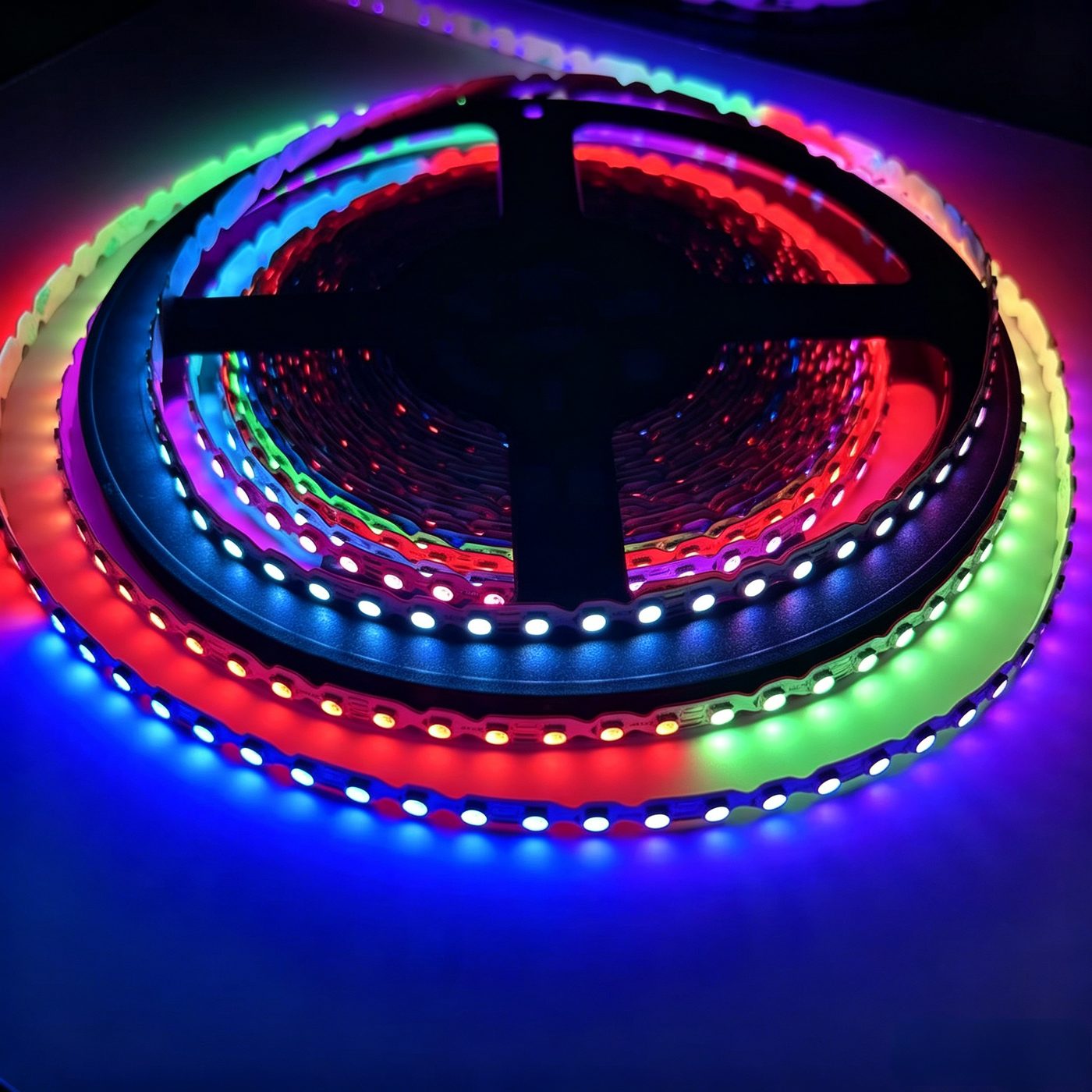
An addressable pixel strip contains an IC at every LED or every three LEDs, so each pixel can be set to an individual colour and brightness from a controller. HFY LED supplies RGB, RGBW and addressable strips on WS2812B, WS2811 and SPI 12 V and 24 V platforms, from 60 to 144 pixels per metre, with custom pixel mapping, lead frames and IP67 sealing for outdoor media facades.
Scope: what this product page covers
This page covers strips driven by SPI or DMX through an external controller. Strips with a built-in power-line protocol, pixel pitch below 5 mm, and transparent or side-emitting pixel strips are custom builds quoted from a drawing. We supply strip and drivers; we do not write show programming or supply media servers.
Specifications
| Protocols | WS2812B, WS2811, WS2815, SPI, DMX512 via controller |
|---|---|
| Pixel density | 30 / 60 / 144 pixels per metre |
| Input voltage | 5 V, 12 V, 24 V (24 V for runs above 5 m) |
| Power | 7 – 43 W/m depending on density |
| Colour depth | 8 bit per channel, 16.7 M colours |
| Refresh rate | 800 Hz or 1.1 kHz, flicker-free on camera |
| Sealing | IP20, IP65, IP67 |
| Lead time | 15–20 working days, 25 days for custom mapping |
Materials
- 4-layer FPC with separate power and data planes
- WS2812B 5050, WS2811 external-IC, WS2815 12 V backup-data builds
- Black FPC for contrast-critical installations
- IP67 silicone tube with potted ends
- Art-Net / DMX to SPI converters and 24 V power supplies
Manufacturing process
- Platform selection The choice between 5 V and 24 V is a cable-run decision. A 5 V strip at 60 pixels/m draws 18 A over 5 m, which needs 12 AWG cable and a feed every 2 m; the same pixel count at 24 V draws 3.75 A and runs 5 m from one feed. For anything beyond a cabinet installation we quote 24 V.
- FPC and data integrity Pixel strips are built on a 4-layer FPC with a dedicated data plane, because a shared ground plane couples switching noise into the data line and produces random colour flicker at the end of long runs. A 220–470 Ω resistor in series with the data line is specified at the first pixel.
- Assembly and optical check Each reel runs a full-colour sweep at 100% and 10% brightness. The 10% test is the one that matters: power distribution faults and cold solder joints that pass at full brightness show as pink or green tint at low levels.
- Mapping and addressing For mapped installations, pixel order, serpentine layout and start-corner are confirmed against the controller file before production, and every reel is labelled with its index range so site wiring does not need to be guessed.
- Sealing and burn-in IP67 builds run 24 hours at rated current after potting. Data and power entry points are the failure sites, so glands are specified rather than potting the cable directly into the profile.
RGB & Pixel LED Strip in production
Typical applications
- Media facades and building outlines
- Stage, club and event set lighting
- Retail window and display animations
- Gaming and entertainment furniture
- Architectural feature walls with pixel mapping
- Smart-home ambient lighting with app control
Quality and documentation
- 100% full-colour and 10% brightness test before packing
- Data-line integrity check on the last pixel of every reel
- Pixel index range labelled per reel for mapped projects
- Flicker-free refresh verified against a camera at 1/1000 s
- CE and RoHS declarations; DMX controllers CE marked
What we do not do
We do not supply pixel strip for permanent outdoor installation without a controller enclosure rated to the site conditions, and we do not support 5 V runs above 5 m — the voltage drop causes colour shift that no controller setting can correct. Show programming, media servers and on-site commissioning are outside our scope; we deliver strip, power and signal infrastructure, tested and labelled.
Technical questions
How many pixels can one controller drive?
A typical SPI output drives 1,024 pixels at 800 Hz, and controllers are specified by output count rather than by pixel total. A 60 px/m strip on a 20 m facade is 1,200 pixels, which needs two outputs or a 24 V WS2815 build with a higher pixel-per-output limit.
Why does my pixel strip flicker at the far end?
Two causes, both measurable. Voltage drop on the 5 V power line causes dimming and colour shift; ground bounce on a shared plane causes data corruption. Feed power from both ends and keep the data line on its own plane — a 24 V strip solves the first and a 4-layer FPC solves the second.
Can I use pixel strip outdoors?
Yes, in an IP67 silicone tube with potted glands, mounted in a channel so water cannot pool. The strip itself survives; the usual failure is the controller or the power supply installed in an IP44 box under a leaking soffit.
Adjacent products and capabilities
COB LED Strip
A COB LED strip is a flexible linear light source in which bare LED dies are bonded directly onto the FPC and sealed under one continuous phosphor layer, so the light is dot-free instead of showing individual emitters. HFY LED builds COB strips at 320, 480 and 504 chips per metre on 24 V, delivering 8–15 W/m at CRI 90–95 with SDCM ≤ 3 colour consistency, in reels from 5 m to 50 m and sealing from IP20 to IP68..
View productSMD LED Strip
An SMD LED strip carries packaged surface-mount LEDs on a flexible PCB at a fixed pitch, which makes it the lowest cost per lumen option for volume lighting. HFY LED produces 2835, 5050 and 5630 strips from 60 to 240 LEDs per metre on 12 V or 24 V, at 100–190 lm/W and CRI 80–90, with reels from 5 m and typical production lead times of 15–20 working days..
View productSilicone Neon Flex
Silicone neon flex is a flexible linear light in a solid silicone profile that diffuses the LED source into an even, continuous line while sealing the electronics to IP67. HFY LED extrudes neon flex in 6×12 mm, 8×16 mm and 10×20 mm profiles on 12 V or 24 V, at 5–12 W/m, in top-bend and side-bend versions, from 2700 K to 6500 K plus RGB and RGBW..
View productQuality & Testing
100% reel electrical test, 24-hour burn-in and SDCM ≤ 3 binning on every order.
Testing capabilitySend a specification, get a quotation in 24 hours
Tell us the product type, run length, wattage, CCT, CRI and IP rating. You will receive a fixed price, a lead time, and the feed and driver arrangement in writing — no obligation, and no sales call unless you ask for one.