
COB LED Strip Lights with Dot-Free, Continuous Light Output
Custom COB LED strips: 320–504 chips/m, CRI 90–95, SDCM ≤3 and no visible dots. 24 V, 8–15 W/m, IP20–IP68, 5–50 m reels, 10–15 day lead times.
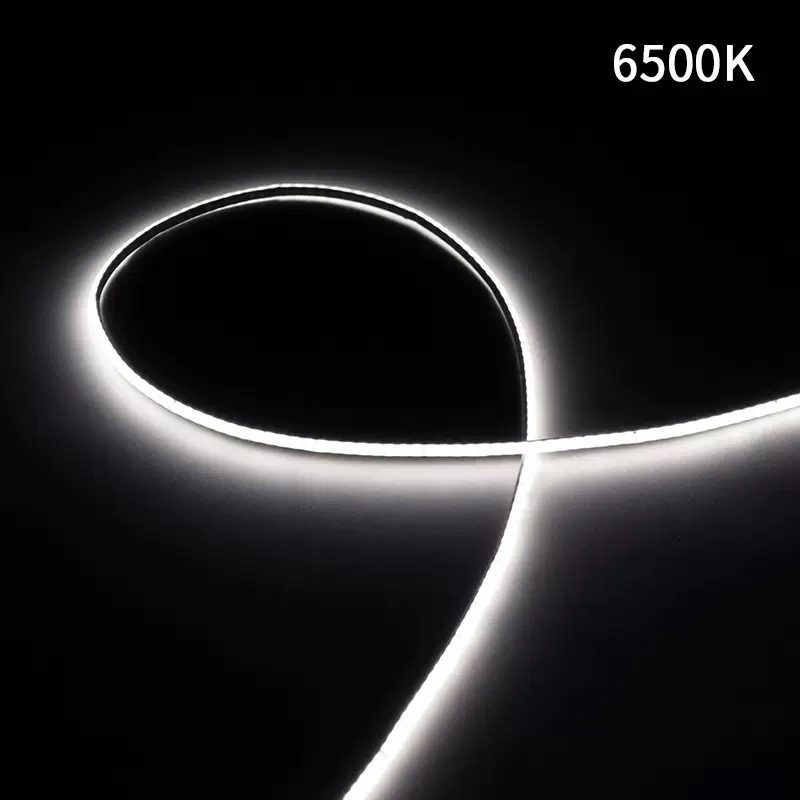
A COB LED strip is a flexible linear light source in which bare LED dies are bonded directly onto the FPC and sealed under one continuous phosphor layer, so the light is dot-free instead of showing individual emitters. HFY LED builds COB strips at 320, 480 and 504 chips per metre on 24 V, delivering 8–15 W/m at CRI 90–95 with SDCM ≤ 3 colour consistency, in reels from 5 m to 50 m and sealing from IP20 to IP68.
Scope: what this product page covers
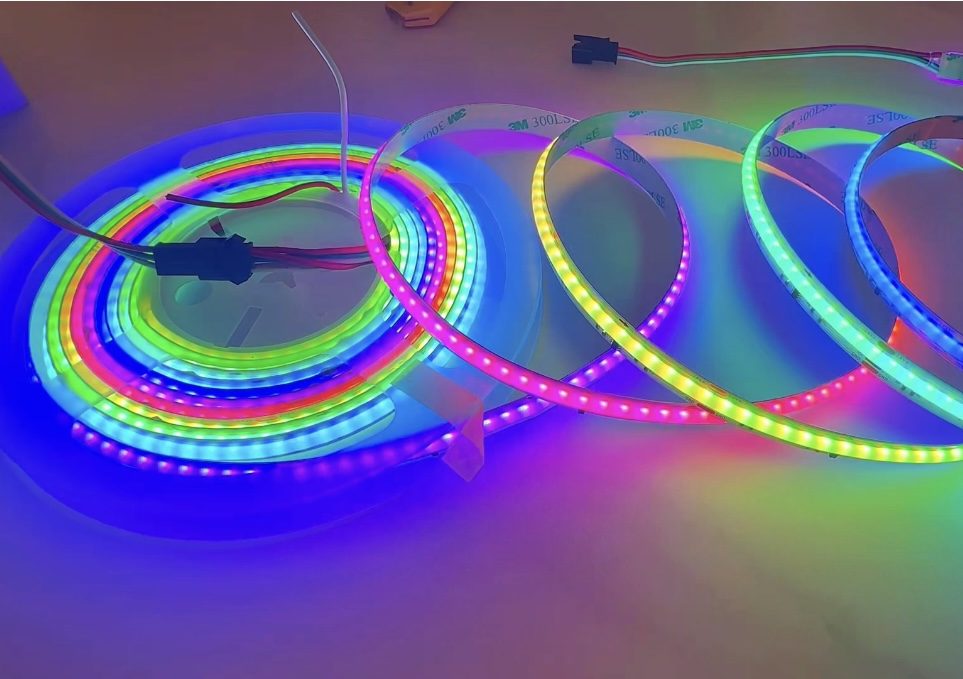
This page covers constant-voltage COB strips for cove lighting, cabinet lighting, linear profiles and mirror backlighting. High-density strips above 504 chips/m, COB strips with individual address control, and constant-current COB modules belong to a custom programme; CCT-tunable and RGB COB are quoted as separate part numbers because the FPC is a different design.
Specifications
| Chip density | 320 / 480 / 608 chips per metre |
|---|---|
| Input voltage | 24 V DC (12 V on request) |
| Power | 8 – 15 W/m |
| Colour rendering | CRI 90 standard, CRI 95 on request |
| Colour consistency | SDCM ≤ 3 within a reel and across reels |
| Cut length | 25 mm (480 chips/m), 50 mm (320 chips/m) |
| FPC width | 8 mm and 10 mm |
| Sealing | IP20, IP54, IP65, IP67, IP68 |
| Reel length | 5 m standard, up to 50 m on one reel at 24 V |
| Lead time | 10–15 working days after sample approval |
Materials
- 3 oz copper flexible PCB for 50 m single-feed runs
- Flip-chip COB dies at 2700 K – 6500 K
- Silicone encapsulation (IP54 / IP65) or full silicone extrusion (IP67 / IP68)
- 3M 300LSE or Tesa adhesive backing for IP20 builds
- Nickel-plated copper end connectors, 22–20 AWG lead wire
Manufacturing process
- FPC design and copper sizing Copper weight is set from the run length, not from habit. A 5 m run at 12 W/m draws 2.5 A at 24 V and loses about 1.6 V over a 3 oz FPC; the same run at 1 oz loses 4.8 V and visibly dims at the far end. Runs above 10 m are quoted with a 3 oz FPC and feed from both ends.
- Die bonding and phosphor coating Dies are bonded at 480 chips/m pitch and covered in a single phosphor and silicone layer, then cured at 150 °C for 60 minutes. Coating thickness is held to ±5 µm because a 10 µm drift in the phosphor layer shifts chromaticity by roughly 2 SDCM, which is the difference between a matched and a mismatched reel.
- Colour binning Each reel is measured on a spectroradiometer and sorted into 3-step MacAdam bins, then reels belonging to the same bin and voltage group are packed together. Bin code, flux and forward voltage are printed on the reel label so a replacement reel matches the installed one two years later.
- Sealing and assembly IP20 builds receive adhesive backing and are packed in antistatic bags. IP65 adds a silicone coating; IP67 and IP68 are extruded into a silicone profile with end caps and cable glands potted in neutral silicone. Connectors are soldered and pull-tested at 30 N.
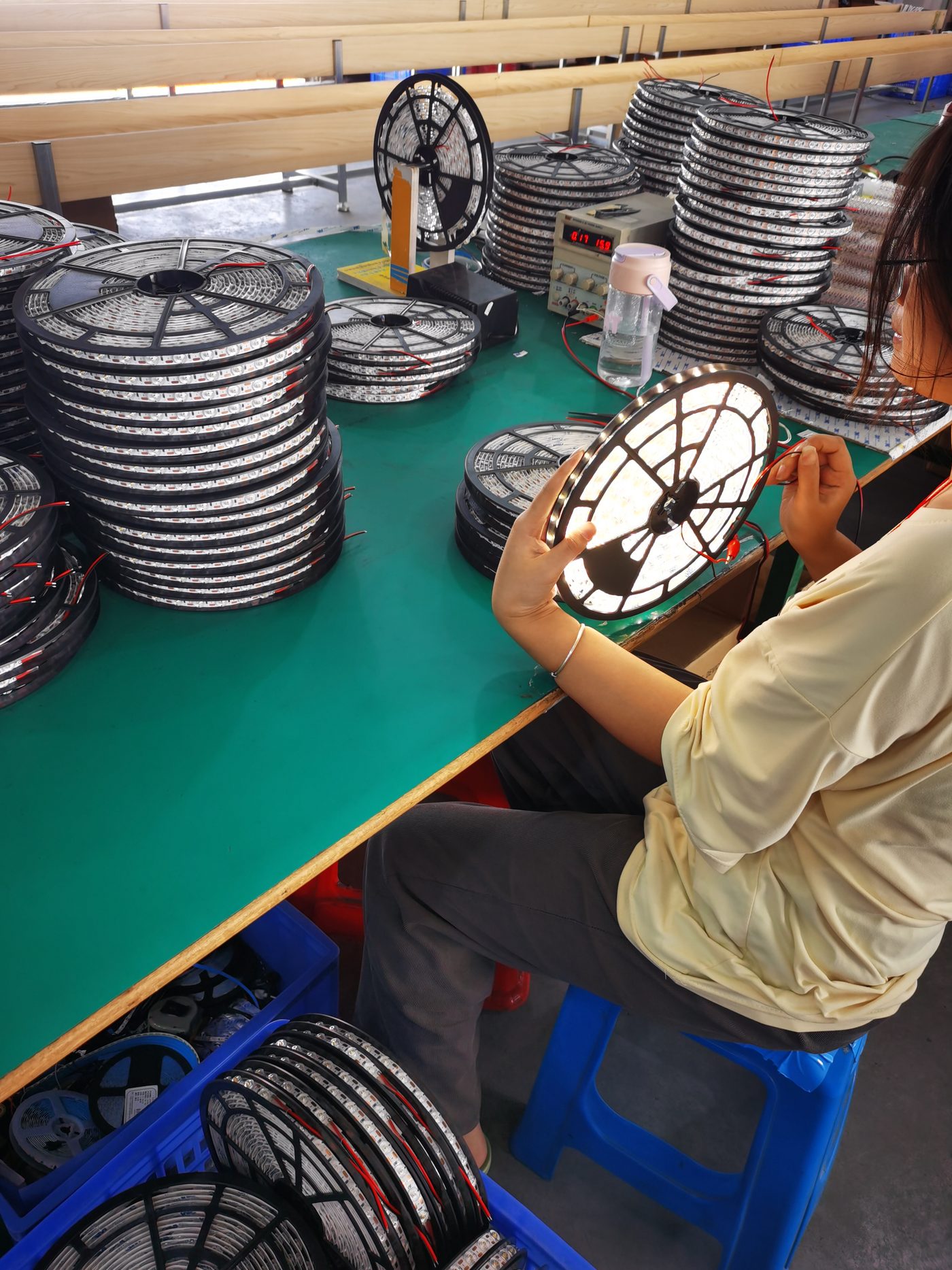
- Aging and final test Every reel runs 24 hours at rated current before packing, and 100% of reels are checked for open segments and forward voltage. A 1,000-hour LM-80 test runs continuously on each die type, with TM-21 extrapolation issued on request.
COB LED Strip in production
Typical applications
- Architectural cove and soffit lighting in hotels and retail
- Aluminium profile linear lighting for offices and joinery
- Cabinet, wardrobe and mirror backlighting
- Display case and museum lighting where dot visibility is unacceptable
- Backlighting of translucent stone and glass panels
- Residential indirect lighting where a seamless line is the design intent
Quality and documentation
- Spectroradiometer binning with SDCM ≤ 3 reported per reel
- 24-hour burn-in at rated current on 100% of reels
- LM-80 data and TM-21 lifetime projection on request
- Voltage drop check on the first and last metre of every long reel
- CE and RoHS documentation; UL/cULus via joint OEM application
What we do not do
We do not supply COB strips for constant-current drivers without a matching driver, and we do not recommend COB strip for wet locations where the strip is immersed in chlorinated water — IP68 extrusion resists jets and temporary immersion, not continuous pool chemistry. Strips longer than 50 m on one feed are not offered: the voltage drop makes the far end visibly dimmer and the correct answer is a parallel feed or a 48 V system.
Technical questions
What is the difference between COB and SMD LED strip?
A COB strip bonds bare dies under one continuous phosphor layer, so there is no visible dot; an SMD strip places packaged LEDs at 8–16 mm pitch, which shows as individual points in a shallow profile. COB costs roughly 20–30% more per metre at the same flux, and it is the right choice when the strip is visible rather than hidden behind a diffuser.
How long a COB strip can I run from one power feed?
Ten metres at 24 V on a 3 oz FPC, feeding both ends. Beyond that the copper resistance produces a visible brightness gradient: a 20 m single-ended run drops about 11% in flux at the far end, which is above the 5% threshold most lighting designers accept.
Can I cut a COB strip anywhere?
No. COB strips have marked cut points every 25 mm at 480 chips/m and every 50 mm at 320 chips/m. Cutting between marks breaks the series circuit and the segment beyond the cut goes dark — this is the single most common installation error we see.
Do you supply samples before a production order?
Yes. A 500 mm sample of any stocked configuration ships within 3 working days, and custom CCT or CRI builds take 7–10 working days. Sample cost is credited against the first production order above 500 m.
Adjacent products and capabilities
SMD LED Strip
An SMD LED strip carries packaged surface-mount LEDs on a flexible PCB at a fixed pitch, which makes it the lowest cost per lumen option for volume lighting. HFY LED produces 2835, 5050 and 5630 strips from 60 to 240 LEDs per metre on 12 V or 24 V, at 100–190 lm/W and CRI 80–90, with reels from 5 m and typical production lead times of 15–20 working days..
View productSilicone Neon Flex
Silicone neon flex is a flexible linear light in a solid silicone profile that diffuses the LED source into an even, continuous line while sealing the electronics to IP67. HFY LED extrudes neon flex in 6×12 mm, 8×16 mm and 10×20 mm profiles on 12 V or 24 V, at 5–12 W/m, in top-bend and side-bend versions, from 2700 K to 6500 K plus RGB and RGBW..
View productLightbox & Side-Emitting Strip
A lightbox LED strip is a side-emitting or zigzag-arranged strip that throws light sideways into the acrylic face of a sign, producing even brightness without the hot spots of a direct-view strip. HFY LED supplies side-view 3014 and 335 strips and zigzag backlight strips at 0.6–1.5 W per module on 12 V or 24 V, sized to box depths from 60 mm to 300 mm, with IP65 sealing for outdoor signs..
View productQuality & Testing
100% reel electrical test, 24-hour burn-in and SDCM ≤ 3 binning on every order.
Testing capabilitySend a specification, get a quotation in 24 hours
Tell us the product type, run length, wattage, CCT, CRI and IP rating. You will receive a fixed price, a lead time, and the feed and driver arrangement in writing — no obligation, and no sales call unless you ask for one.