
COB Die Bonding and Continuous Phosphor Encapsulation
In-house COB die bonding at 320–504 chips/m, phosphor coating held to ±5 µm, 24-hour burn-in and SDCM ≤3 binning on every reel produced.
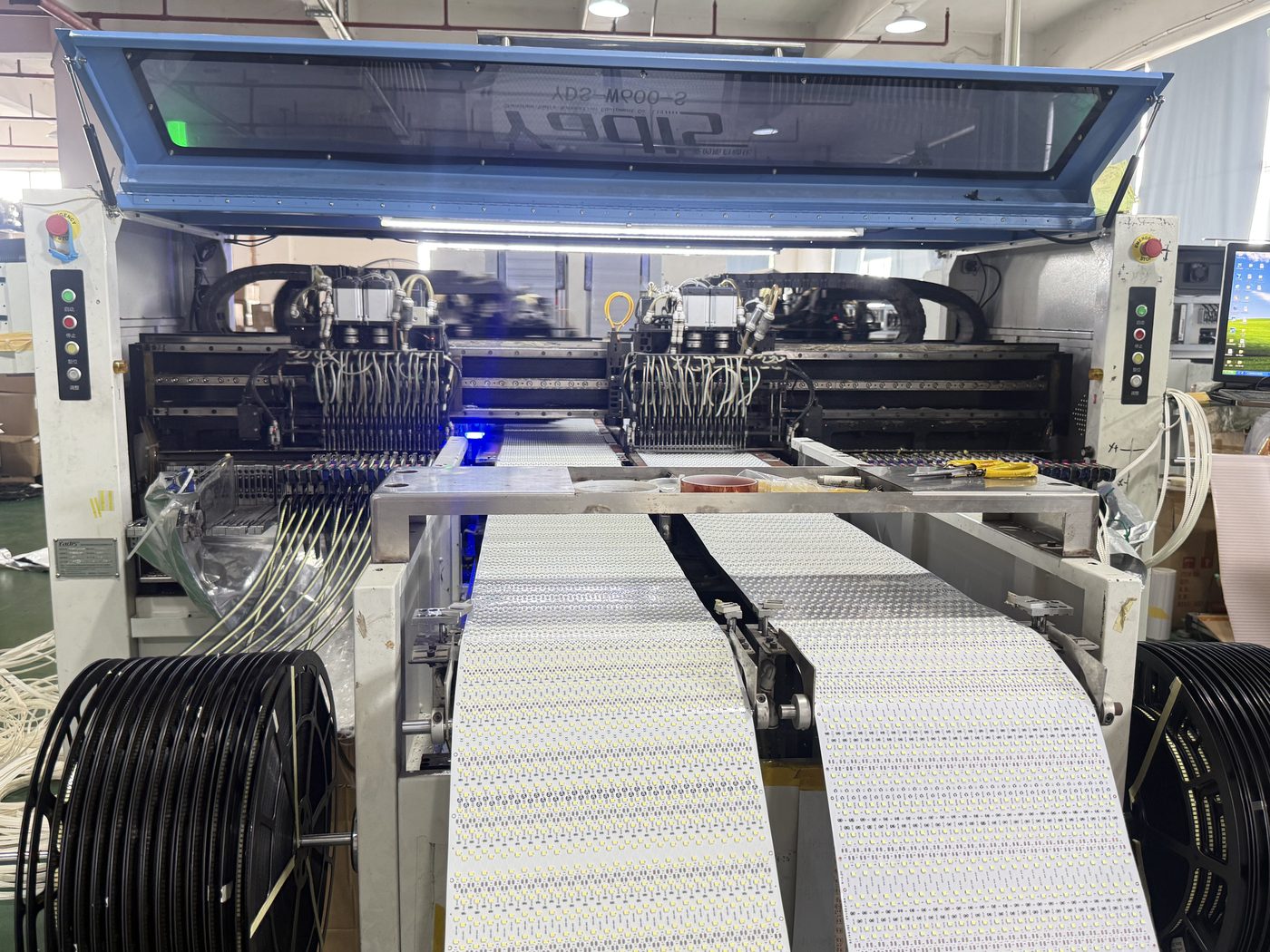
COB encapsulation bonds bare LED dies onto the flexible PCB and covers them with one continuous phosphor layer, which is what removes the dot pattern of an SMD strip. HFY LED runs die bonding at 320 to 504 chips per metre with phosphor thickness held to ±5 µm, cures at 150 °C, and burn-tests every reel for 24 hours before binning.
When this process applies
We bond dies on 8 mm and 10 mm FPC in reels up to 50 m. Dies are sourced from Sanan and Bridgelux for standard CCT and from Nichia on request. Custom spectrum work — horticulture, 1800 K candlelight, cyan-reduced — is quoted from a spectrum target with a 25-day lead time.
Technical specifications
| Chip density | 320 / 480 / 504 chips per metre |
|---|---|
| Die placement accuracy | ±25 µm |
| Phosphor thickness control | ±5 µm |
| Cure profile | 150 °C for 60 minutes |
| CCT range | 1800 K – 6500 K |
| CRI | 90 standard, 95 on request |
| Reel length | 5 – 50 m |
Where it is the right choice
- Cove, profile and cabinet lighting where the source is visible
- Mirror and stone backlighting requiring a seamless line
- Retail displays with a shallow diffuser
- Replacements for SMD strip where dot visibility caused a complaint
Where it is the wrong choice
Stating this explicitly matters more than a capability list: if your part falls into one of these categories, another process will cost you less.
- Projects where the strip sits behind a 3 mm or thicker opal diffuser — SMD is cheaper and looks identical
- Constant-current architectural modules, which are a different FPC and driver architecture
- Addressable pixel effects, which need an IC per pixel rather than a continuous phosphor layer
Equipment
- 3 COB die bonding lines with ±25 µm placement
- Continuous phosphor dispensing with in-line thickness gauge
- Reflow and cure ovens under nitrogen
- Spectroradiometer binning station
- 24-hour burn-in racks, 2,000 reel capacity
Process questions
Why does phosphor thickness matter so much?
Chromaticity shifts roughly 0.2 SDCM per micrometre of phosphor thickness at 3000 K. Holding ±5 µm keeps a production lot inside a 3-step MacAdam ellipse; a ±15 µm process spreads the same lot across two bins, and the mismatch only shows when two reels are installed side by side.
What is the minimum order for a custom CCT?
500 m, which is 100 reels of 5 m. Below that the phosphor batch setup and binning effort dominate the cost, and we would rather quote a standard 2700 K or 3000 K bin than sell a custom run at a price that does not make sense.
Related capabilities and products
Colour Binning
Colour binning measures each production reel and sorts it by chromaticity, flux and forward voltage so that strips installed side by side match. HFY LED measures every reel on a spectroradiometer, bins to SDCM ≤ 3 within 3-step MacAdam ellipses, and issues LM-79 flux reports plus LM-80 and TM-21 lifetime data on request..
View capabilityKnowledge Base
Tolerance tables, cost mechanics and DFM rules written for buyers rather than engineers.
Read articlesSend a specification, get a quotation in 24 hours
Tell us the product type, run length, wattage, CCT, CRI and IP rating. You will receive a fixed price, a lead time, and the feed and driver arrangement in writing — no obligation, and no sales call unless you ask for one.