Quality Control, Burn-In Testing and Photometric Documentation
Incoming die verification, 100% reel electrical test, 24-hour burn-in, IP pressure testing and LM-79 / LM-80 / TM-21 documentation under ISO 9001.
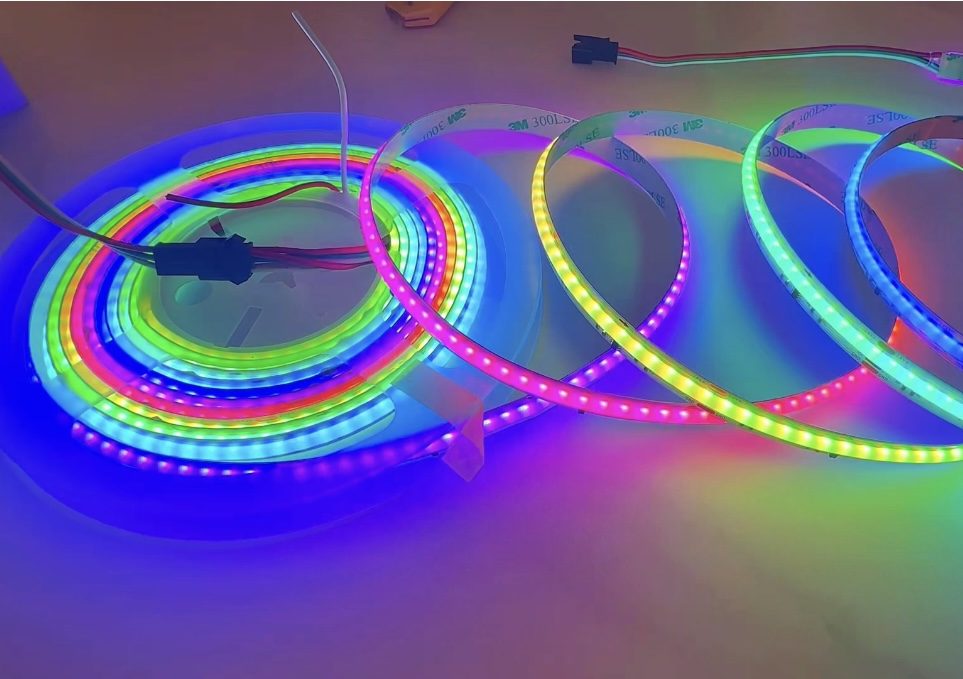
Quality control for LED strip combines incoming component verification, in-process optical inspection and end-of-line electrical and photometric testing. HFY LED tests 100% of reels for forward voltage and open segments, burns in every reel for 24 hours at rated current, pressure-tests outdoor assemblies, and operates under ISO 9001:2015 with LM-79, LM-80 and TM-21 documentation available per lot.
When this process applies
Testing covers electrical, photometric and ingress protection performance of the strip. Luminaire-level safety certification, EMC testing of complete fixtures and third-party witness testing are carried out by accredited laboratories and quoted at cost.
Technical specifications
| Quality system | ISO 9001:2015 |
|---|---|
| Electrical test | 100% of reels, forward voltage and current |
| Burn-in | 24 hours at rated current on every reel |
| Ingress test | 0.3 bar pressure, 100% of outdoor assemblies |
| Photometric reporting | LM-79 report per lot; LM-80 data per die type |
| Lifetime projection | TM-21, L70 and L80 at 6,000 hours |
| Traceability | Lot record retained 5 years |
Where it is the right choice
- Tender submissions requiring photometric evidence
- Brands that need a lot-level record for warranty claims
- Projects mixing production lots in one installation
- Customers auditing a new supplier before a first order
Where it is the wrong choice
Stating this explicitly matters more than a capability list: if your part falls into one of these categories, another process will cost you less.
- Luminaire safety certification (CE / UL for a complete fitting), which applies to the finished product
- EMC testing of drivers and controllers, carried out by the driver supplier
- In-situ performance verification on an installed site
Equipment
- Automatic reel tester for voltage, current and continuity
- Burn-in racks, 2,000 reels at rated current
- Integrating sphere and spectroradiometer
- Pressure test rigs and IPX5 spray booth
- LM-80 ageing racks with 6,000-hour capacity
Process questions
Why burn in every reel for 24 hours?
Because early failures cluster in the first few hours. A die-bond void or a cold solder joint usually fails within 24 hours at rated current, and catching it in our plant costs a reel; catching it after installation costs a site visit. The burn-in adds roughly 0.8% to unit cost and removes most of the field failure modes.
What documents come with a shipment?
A lot certificate with bin code, flux, forward voltage and burn-in record, plus CE and RoHS documentation. LM-79 reports, LM-80 data and TM-21 projections are issued on request, and third-party test reports are available at cost.
Related capabilities and products
Colour Binning
Colour binning measures each production reel and sorts it by chromaticity, flux and forward voltage so that strips installed side by side match. HFY LED measures every reel on a spectroradiometer, bins to SDCM ≤ 3 within 3-step MacAdam ellipses, and issues LM-79 flux reports plus LM-80 and TM-21 lifetime data on request..
View capabilityKnowledge Base
Tolerance tables, cost mechanics and DFM rules written for buyers rather than engineers.
Read articlesSend a specification, get a quotation in 24 hours
Tell us the product type, run length, wattage, CCT, CRI and IP rating. You will receive a fixed price, a lead time, and the feed and driver arrangement in writing — no obligation, and no sales call unless you ask for one.